
State Bank of India, Tech Mahindra, Larsen & Toubro, Tata Steel, Sun Pharma, Infosys, HCL Tech, Axis Bank, Tata Consultancy Services and NTPC were among the biggest laggards among Sensex shares. Nestle, Hindustan Unilever, Titan, Power Grid, UltraTech Cement and ITC were among the gainers.

The equity benchmark indices posted their strongest weekly gains in years, driven by bargain hunting and optimism over a reversal in foreign portfolio investor (FPI) outflows. The Sensex rose 558 points, or 0.7 per cent, on Friday to close at 76,906, while the Nifty 50 gained 160 points to end at 23,350. Over the past five sessions, both indices advanced around 4.3 per cent - marking the Sensex's best weekly performance since July 22, 2022, and the Nifty 50's strongest rally since February 5, 2021.

S&P Global Ratings on Wednesday upgraded India's sovereign rating outlook to positive from stable while retaining the rating at 'BBB-' on robust growth and improved quality of government expenditure. S&P said it could upgrade India's sovereign rating in the next 2 years if the country adopts a cautious fiscal and monetary policy that diminishes the government's elevated debt and interest burden while bolstering economic resilience.
With concern on food inflation ebbing with the monsoon progressing well, the Reserve Bank of India (RBI) is warming up to the idea of a change in stance to "neutral" from "withdrawal of accommodation", according to economists. In his speech on Thursday during the annual event of the Federation of Indian Chambers of Commerce and Industry-Indian Banks' Association, RBI Governor Shaktikanta Das said: "The balance between inflation and growth is well-poised."
The government has invited applications for the post of deputy governor of the Reserve Bank of India (RBI) from interested candidates with at least 25 years of experience and below 60 years of age as on January 15, 2025. One of the deputy governors, Michael Patra's current term will end on 15 January. The last date of submission of applications is November 30, 2024.

'Challenge is basically near-term growth as the outlook has turned a bit adverse.'

Miller said that US President Donald Trump has a 'tremendous' relationship with Prime Minister Narendra Modi, and that the peace options for the region are on the table.

The Reserve Bank on Friday said India is poised to become the growth engine of the world as it retained the GDP projection for the current fiscal at 6.5 per cent. Unveiling the bi-monthly monetary policy review, Reserve Bank of India (RBI) Governor Shaktikanta Das said the domestic economy exhibits resilience on the back of strong demand.

The country's forex reserves touched a record high of $675 billion on August 2, Reserve Bank Governor Shaktikanta Das said on Thursday. The previous all-time high for the kitty was $670.857 billion on July 19 this year, and the last reported reserve was $667.386 billion as on July 26. Das said overall, the country's external sector "remains resilient" as indicated by an improvement in key indicators.

'The RBI's MPC will maintain the current policy rates (6.50%) at the policy meeting, given ongoing inflationary pressures.'

Reserve Bank of India (RBI) is unlikely to cut the benchmark interest rate at its upcoming monetary policy review meeting, taking place soon after the announcement of the Lok Sabha election results, amid inflation challenges, said experts. The Monetary Policy Committee (MPC) may also refrain from rate cut as economic growth is picking up, notwithstanding the elevated interest rate of 6.5 per cent (repo) prevailing since February 2023. The meeting of the Reserve Bank Governor Shaktikanta Das headed MPC is scheduled for June 5 to 7.
The RBI is likely to reduce the key interest rate by 25 basis points this week after keeping it on hold for two years, complementing the Union Budget initiatives to push consumption-led demand, though the sliding rupee continues to be a concern. As the retail inflation has remained within the Reserve Bank's comfort zone (less than 6 per cent) for most of the year, the central bank can take rate action to boost growth hit by sluggish consumption, opined experts.

The liquidity deficit in the banking system crossed Rs 2 trillion again on Monday, despite the second instalment of cash reserve ratio (CRR) reduction coming into effect from December 28.

An article on 'State of the Economy' in the monthly Bulletin also said the improvement in the outlook for agriculture and the revival of rural spending have turned out to be the bright spots in the evolution of demand conditions. Consumer price inflation ticked up in June 2024 after three consecutive months of moderation as a broad flare-up in vegetable prices halted the overall disinflation that had been underway, it said.

In an eventful week ahead, stock markets may face volatile trends before the RBI's interest rate decision and the US inflation data announcements, as investors continue to assess the broader implications of US tariffs on global economy and inflation, analysts said. Investors fear that a full-blown trade war will impact global trade and economic growth, according to market experts.

Stock markets will be driven by further developments on the US-China tariff war front along with quarterly earnings announcements from IT majors Wipro and Infosys in a holiday-shortened week, analysts said. Global market trends and trading activity of foreign investors would also dictate market movement this week, experts noted.

The retail inflation eased to a four-month low of 4.87 per cent in October, mainly due to cooling prices of food items, government data showed on Monday. The Consumer Price Index (CPI) based retail inflation fell to a three-month low of 5.02 per cent in September. The previous low inflation was recorded at 4.87 per cent in June.

Stock markets would take cues from the biggest event of the week -- the US Fed interest rate decision, besides tracking the trends in global markets and trading activity of foreign investors, analysts said. Last week, a heavy decline in smallcap, midcap firms, foreign fund outflows and elevated crude oil prices in the international market dented investors' sentiments. Experts said equity markets may remain volatile in the near-term amid a host of global central bank's monetary policy decisions lined up during the week.
The Reserve Bank will hold a special meeting of its rate-setting committee on November 3 to prepare a report for the government on why it failed to keep retail inflation below the target of 6 per cent for three consecutive quarters since January. The six-member Monetary Policy Committee (MPC) headed by RBI Governor Shaktikanta Das will prepare the report on reasons for failure to meet the inflation target as well as the remedial measures the central bank is taking to bring down prices in the country. "Under the provisions of Section 45ZN of the Reserve Bank of India (RBI) Act 1934... an additional meeting of the MPC is being scheduled on November 3, 2022," RBI said in a statement on Thursday.
Reserve Bank on Thursday retained the growth and inflation projection at 7.2 per cent and 4.5 per cent respectively for the current fiscal amid expectations of a normal monsoon. In its last bi-monthly monetary policy review in June, RBI had projected real GDP growth and retail inflation at the same.

From the 30-share blue-chip pack, Adani Ports jumped over 5 per cent. NTPC, Tata Steel, Bajaj Finserv, Zomato, Bajaj Finance, Tata Motors, State Bank of India, IndusInd Bank and Maruti were among the other big gainers. From the 30-share pack, Hindustan Unilever, Titan, Tata Consultancy Services, Infosys and UltraTech Cement were the other laggards.

Foreign investors withdrew Rs 10,355 crore from the country's equity markets in the last four trading sessions this month due to sweeping tariffs imposed by the US on most nations, including India. The outflow occurred after a net investment of Rs 30,927 crore in the six trading sessions from March 21 to March 28. This infusion helped reduce the overall outflow for March to Rs 3,973 crore, according to data from the depositories.

United States President Donald Trump once again mounted a sharp attack on India and Russia for their close ties and said that the two countries can take their 'dead economies down together'.

Reserve Bank of India (RBI) Governor Shaktikanta Das has said the decision on interest rate moderation will be based on long-term inflation trajectory and not monthly data. The Monetary Policy Committee (MPC) headed by the RBI Governor is scheduled to meet between October 7 and 9 and take call on interest rate. The RBI kept the repo rate unchanged at 6.5 per cent for the ninth time in a row amid risks from higher food inflation.

Among Sensex shares, Mahindra & Mahindra, Bharti Airtel, Bajaj Finance, Zomato, Nestle, Bajaj Finserv, Maruti and Titan were the biggest gainers. Sun Pharma, Power Grid, Tata Consultancy Services, Tech Mahindra, Asian Paints and Tata Motors were among the laggards.

Jio Finance, a wholly owned subsidiary of Jio Financial Services, is likely to delay its maiden bond issue of Rs 3,000 crore, originally scheduled for this month. The decision comes amid expectations of softening yields in April because the Reserve Bank of India's (RBI's) monetary policy committee (MPC) is widely expected to cut the policy repo rate by another 25 basis points, sources said.

The impact of RBI's monetary policy on the Aam Aadmi of India is going to be minimal.

Experts expect the central bank to hike key short-term policy rates by 25 basis points to check inflation.

The Reserve Bank of India on Friday revised upwards the GDP growth projection for the current fiscal to 7.2 per cent from 7 per cent on rising private consumption and revival of demand in rural areas. Unveiling the bi-monthly monetary policy, RBI Governor Shaktikanta Das said estimates released by the National Statistical Office (NSO) placed India's real gross domestic product (GDP) growth at 8.2 per cent in 2023-24. "During 2024-25 so far, domestic economic activity has maintained resilience," he said, adding that manufacturing activity continues to gain ground on the back of strengthening domestic demand.

In the context of RBI's view that the real interest rate, defined as the repo rate less "look forward" CPI, should be around 150-200 basis points.

The Reserve Bank of India on Friday decided to keep the policy rate unchanged at 6.5 per cent for the fifth time in a row as it maintains a tight vigil on inflation. The rate increase cycle was paused in April after six consecutive rate hikes, aggregating to 250 basis points since May 2022. Announcing the bi-monthly monetary policy, RBI Governor Shaktikanta Das said the Monetary Policy Committee (MPC) unanimously decided to keep the repo rate unchanged at 6.5 per cent.

Retail inflation dipped marginally to a nearly six-year low of 3.34 per cent in March due to a decline in prices of vegetables and protein-rich items. The Consumer Price Index (CPI) based inflation was 3.61 per cent in February and 4.85 per cent in March last year.

With the RBI infusing Rs 7.5 lakh crore in liquidity -- and possibly more in the future -- the short- to medium-term corporate bond market is expected to benefit.

Prospects of a bumper kharif harvest are expected to lower food inflation in the coming months, making the country's inflation outlook benign, the Union Ministry of Finance (FinMin) said in its monthly economic report for October released on Monday.

The Reserve Bank of India's interest rate decision, macroeconomic data and global trends will drive investors' sentiment this week, with markets hoping to continue the positive momentum after ending FY24 on a buoyant note, analysts said. In addition, the trading activity of foreign investors, the rupee-dollar trend and the movement of global oil benchmark Brent crude would also influence trading in equity markets. The 30-share BSE Sensex climbed 14,659.83 points or 24.85 per cent in the 2023-24.

India Ratings on Thursday said that any broad-based or strong recovery in corporate capital expenditure was unlikely in the upcoming financial year 2026 (FY26) due to uncertainty of domestic and external demand. The uncertainty is adversely affecting the overall corporate sector capex. Interest rates on credit are not the primary deterrent to decisions about capital expenditure, said Soumyajit Niyogi, director, core analytical group, Ind-Ra, in a webinar on the credit market outlook.

The 25 per cent US tariffs, plus a penalty for Russian imports, could dent India's GDP growth by 30 basis points in the current fiscal, but the higher duty is unlikely to significantly affect India's domestic demand-driven economy, Barclays said on Thursday. If the 25 per cent tariff, announced by US President Donald Trump on Wednesday, is implemented from August 1, the effective average US import tariff on Indian goods will rise to 20.6 per cent in trade-weighted terms, as per Barclays estimates.
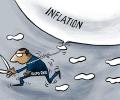
'As the Budget has taken some measures to spur growth, similar action from the MPC may be expected.'

The central bank is reviewing its monetary policy on April 20 and is widely expected to further hike its key rates and/or ratio to rein in rising inflation.

With inflation surging into double digits, the Reserve Bank of India on Tuesday said it may take monetary action to tame the rising prices ahead of the scheduled review of the policy on July 27.
